

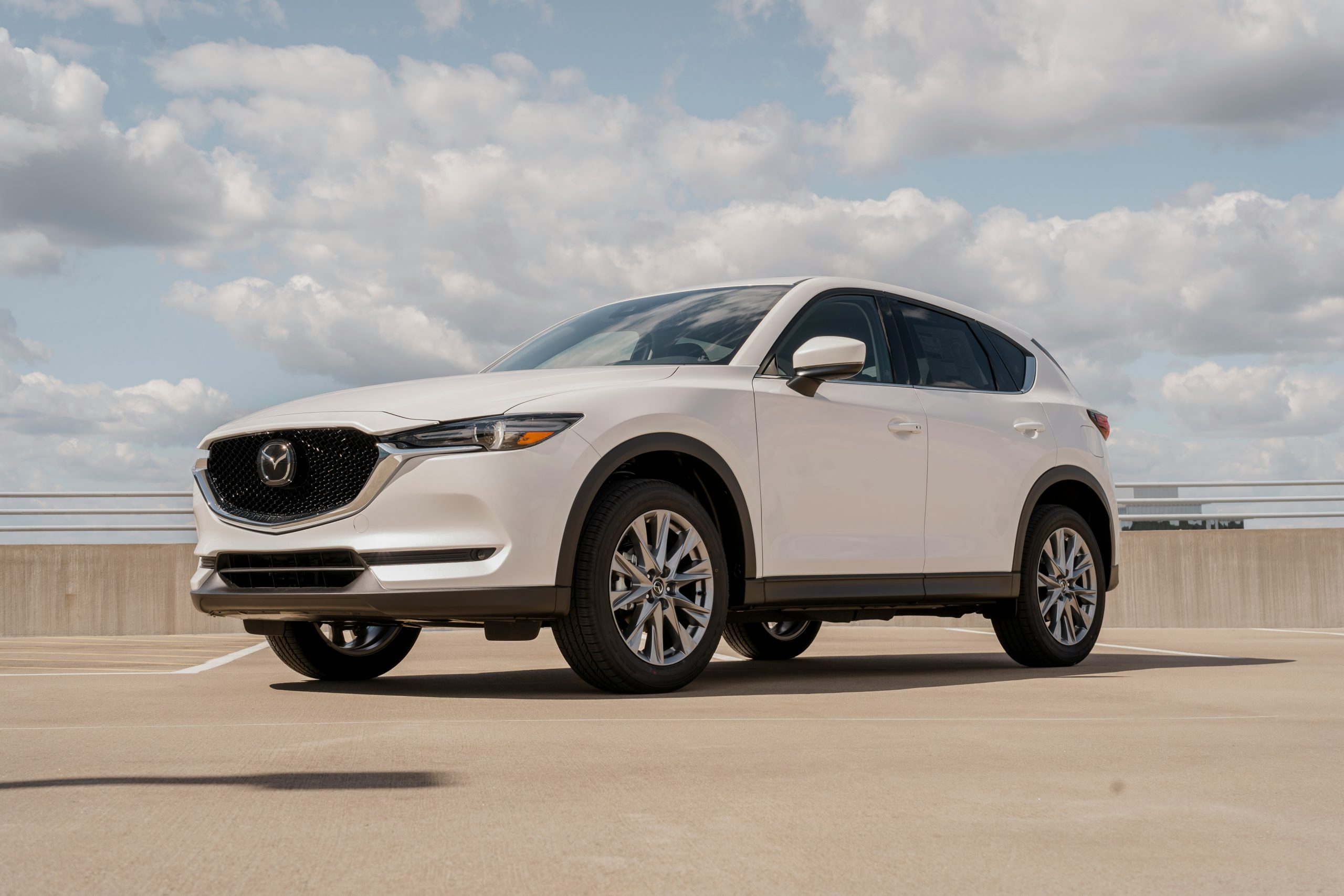
The Mazda CX-5 and CX-30 crossover SUVs are favorites among Pennsylvanian drivers looking for reliable, good-looking vehicles. Although both share Mazda’s design philosophy and technology, their dimensions, handling, and features differ. Our Mazda CX-5 vs. CX-30 comparison will help you choose the right fit for your daily commute, parking situation, and Conshohocken lifestyle.
Exterior Dimensions and Size Comparison
The CX-5 is a compact SUV, and the CX-30 is a subcompact SUV. The CX-5 is 180.1 inches long compared to the CX-30’s 173 inches. There’s a height difference of 5 inches, with the CX-5 standing 66.1 inches tall vs. the CX-30’s 61.7 inches. Width-wise, the CX-5 spans 72.6 inches, while the CX-30 measures 70.7 inches.
The CX-30’s smaller size allows for easier downtown parking and sharper turns. The CX-5 offers more highway stability on the Blue Route and more cargo room for longer journeys to Philadelphia.
Interior Space and Cargo Capacity Analysis
The interior dimensions are surprisingly varied. The CX-30’s front legroom is 41.7 inches compared to the CX-5’s 41 inches. Backseat passengers have more room in the CX-5 with 39.6 inches of rear legroom, while the CX-30 has 36.3 inches. Headroom follows this pattern — the CX-5 has 39.7 inches up front and 39 in back, while the CX-30 offers 38.1 inches in front and 38.3 in back.
The biggest difference is in the cargo space. The CX-5 has 29.1 to 30.9 cubic feet behind the rear seats vs. the CX-30’s 20.2 cubic feet. With the rear seats folded, there’s 59.3 to 59.6 cubic feet in the CX-5 compared to 45.2 cubic feet in the CX-30. The CX-30’s trunk features a low floor and wide opening for easy loading, a 60/40-split folding seat, and hidden storage spots.
Engine Performance and Fuel Economy
The CX-30’s standard 2.5L four-cylinder produces 191 horsepower and 186 lb-ft of torque. The CX-5 produces 187 horsepower and 185 to 186 lb-ft using the same engine. Turbo options on the CX-30 generate 227 to 250 horsepower and 310 to 320 lb-ft of torque, while the CX-5’s turbo delivers 227 to 256 horsepower and identical torque numbers.
Gas mileage favors the CX-30, with an EPA-estimated 26 mpg in the city and 33 mpg on the highway vs. the CX-5’s 23 mpg in the city and 29 mpg on the highway. Real-world testing shows the non-turbo CX-5 typically achieves 26 to 30 mpg combined. Both turbo versions drop to 22 mpg in the city, but the CX-30 wins on the highway with 30 mpg vs. the CX-5’s 27 mpg. The tank capacity is 12.7 gallons in the CX-30 and 15.3 gallons in the CX-5.
Technology and Infotainment Features
Both models feature Mazda’s latest tech. The CX-30 starts with an 8.8-inch display, while the Carbon Edition and higher trims include a standard 10.25-inch display, which is optional on some lower trim levels. The 10.25-inch screen is standard in the CX-5. Mazda’s 2025 upgrades include better navigation and voice commands and wireless Apple CarPlay, Android Auto, and phone charging in the Carbon Editions and upward.
Multiple USB ports and optional premium sound systems are standard in both models. The speaker count and setup depend on the trim level and packages you choose.
Safety Features and Ratings Comparison
The Mazda i-ACTIVSENSE safety suite is standard in both models and includes lane-keep assist, blind-spot monitoring, rear cross-traffic alerts, and Mazda Radar Cruise Control. The 2025 CX-30 earned both the Top Safety Pick+ award from the Insurance Institute for Highway Safety and a five-star overall rating from the National Highway Traffic Safety Administration.
Advanced features include automatic emergency front and rear braking and forward collision warning. Higher trims add a 360-degree monitor and a windshield-projected head-up display. Upper trims on the CX-5 get Traffic Jam Assist for semi-automated driving in stop-and-go traffic.
Pricing Structure and Value Proposition
Let’s look at the Mazda CX-5 vs. CX-30 price structure. The CX-30 has a starting MSRP of $25,195, while the CX-5 starts at $28,770 for the entry models. The Carbon Edition has an MSRP starting at $30,140 for the CX-30 and $32,350 for the CX-5. The top-of-the-range CX-30 starts at $37,150, and the CX-5 Turbo Signature starts at $40,800.
Both Mazda models offer eight trim levels, so you’ve got options regardless of size preference. Choose the CX-30 if you want a sporty, efficient SUV at a lower price. The CX-5 SUV is ideal if you need more space and don’t mind paying extra.
Towing Capacity and Utility Features
The CX-30 is not designed for towing. The CX-5 has a 2,000-pound towing capacity when properly equipped, which includes safety gear, a hitch, and sway control to keep your trailer stable. This is enough to tow a small trailer, a pop-up camper, dirt bikes, or a couple of kayaks.
Each model offers various extras that might interest you. The CX-30 has an available power liftgate for easier access, while the CX-5 adds ventilated seats. Both support roof racks for extra cargo and handle all-weather driving with their all-wheel-drive systems.
Which Is Better, the Mazda CX-5 or CX-30?
Ultimately, it comes down to your daily needs, family size, and budget. Consider the CX-30 if you’re looking for improved gas mileage, easier parking, and a lower price tag while still enjoying Mazda’s quality and style. It’s perfect for city dwellers, young professionals, and empty nesters who prioritize efficiency over maximum space. Choose the CX-5 for additional cargo room, comfortable back seats, and towing capabilities, even though it costs more up front and at the pump.
Find Your Ideal Mazda in Conshohocken Today
Both the CX-5 and CX-30 deliver Mazda’s fun driving feel and reliability. We’d love for you to try both options with a test-drive at John Kennedy Mazda of Conshohocken, where our team can walk you through their features and explain our financing options. Whether you’re leaning toward the nimble CX-30 or roomy CX-5, contact us today to book your test-drive and see which Mazda SUV fits your Conshohocken lifestyle best.
Connect with us


- July 2026
- June 2026
- April 2026
- March 2026
- February 2026
- January 2026
- December 2025
- November 2025
- October 2025
- September 2025
- August 2025
- July 2025
- June 2025
- May 2025
- April 2025
- March 2025
- February 2025
- January 2025
- December 2024
- November 2024
- October 2024
- September 2024
- August 2024
- May 2024
- April 2024
- March 2024
- February 2024
- January 2024
- December 2023
- November 2023